


The MagicPro 3.0 — The 4-Point NeuroReset™ Neck Device
Developed with Dr. Richard Calloway, FRCP — Consultant Rheumatologist (ret.), 32 Years in the NHS
★★★★★ (4.8/5 Rated by 1,274+ Verified Customers)
As featured in Fibromyalgia Journal — Independent Health Review UK
- ✓ Switch Off the Pain Alarm at Its Source – Six contact points rest exactly on the 4 "pain switches" at the base of your skull — the same four points printed inside the fibromyalgia criteria since 1990 — where hands, heat pads and pills never reach long enough.
- ✓ Wake Up Without the Morning "Inventory" – 15 minutes in the evening calms the signals that keep your pain filter from its night shift — so you stop scanning your body before your feet even touch the floor.
- ✓ Stop Accepting "It's Just Your Age" – Clinic-grade neuromodulation at home, while your bloods keep coming back "normal" and everyone else waits 18 months for a pain clinic that discharges you anyway.
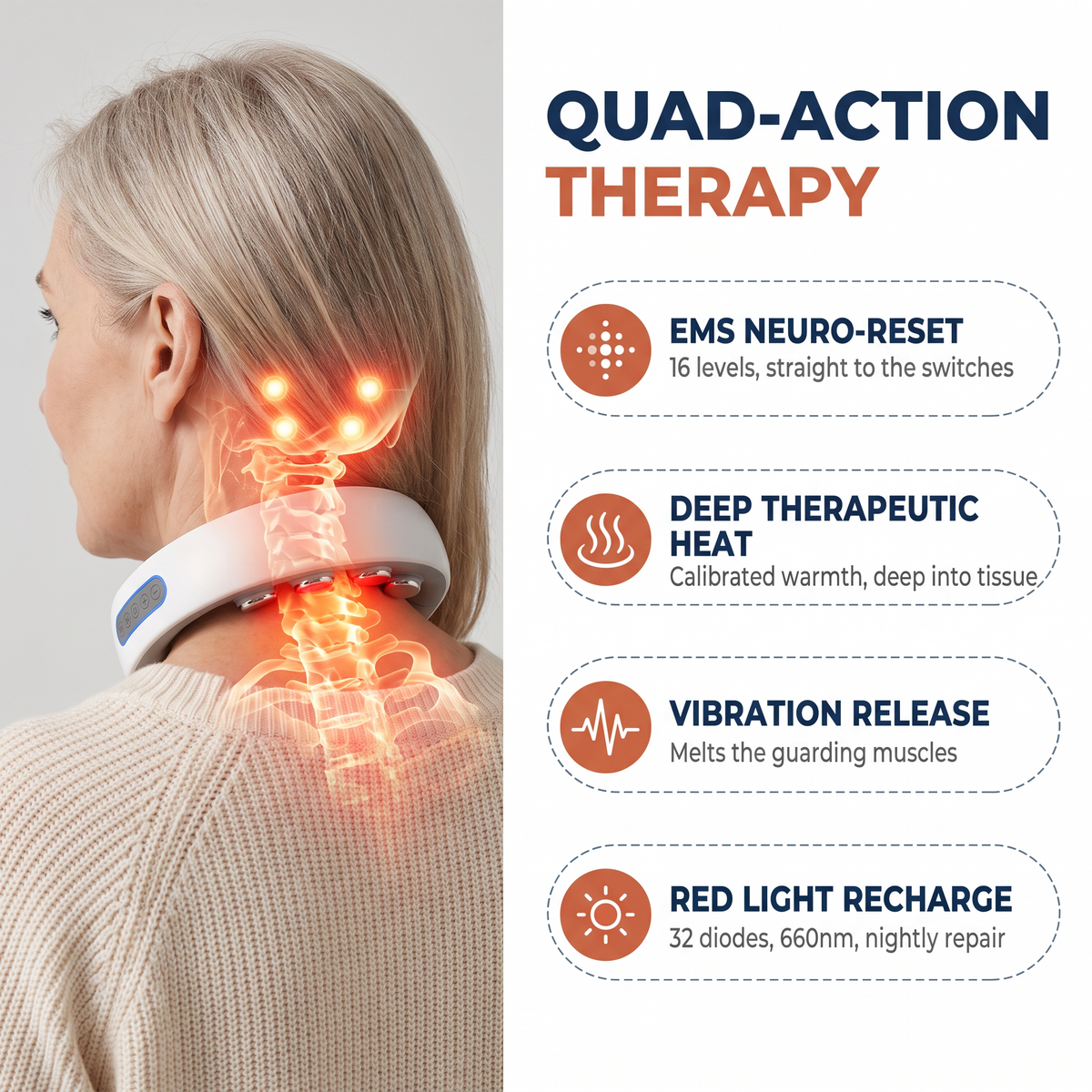
- ✓ Four Clinic Technologies. One Button. Zero Drugs – EMS with 16 intensity levels, therapeutic warmth, targeted vibration and 32 red-light diodes in a single wearable session. Nothing enters your bloodstream. No pads, no refills, no subscription — ever.
Couldn't load pickup availability


The 15-Minute Evening Ritual
The only pain routine you'll never quit is the one that asks nothing of you but sitting down.
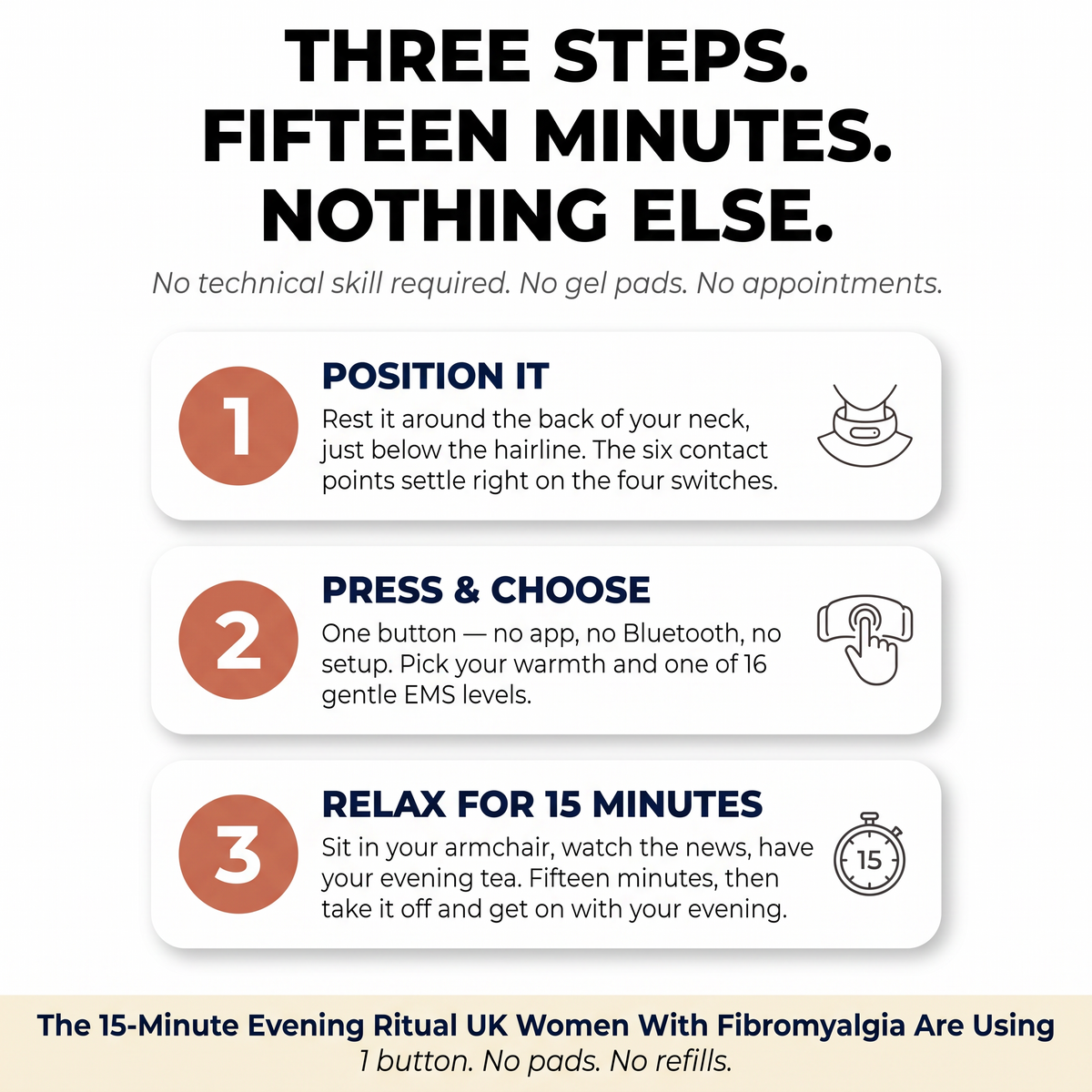
POSITION
Rest the MagicPro 3.0 around the back of your neck, just below the hairline. The six contact points settle flat against your skin at the base of the skull — exactly where the four switches live.
PRESS
One button. Warmth spreads first, then a gentle pulsing as the EMS begins its work. Sixteen intensity levels — start low, find your comfort, let the device run its four-phase cycle.
RELAX
Fifteen minutes in your armchair, in bed, wherever the evening finds you. No gel pads, no wires, no app, no appointment. When it switches off, you're ready for the night.

Why It Works: Reach the Switches
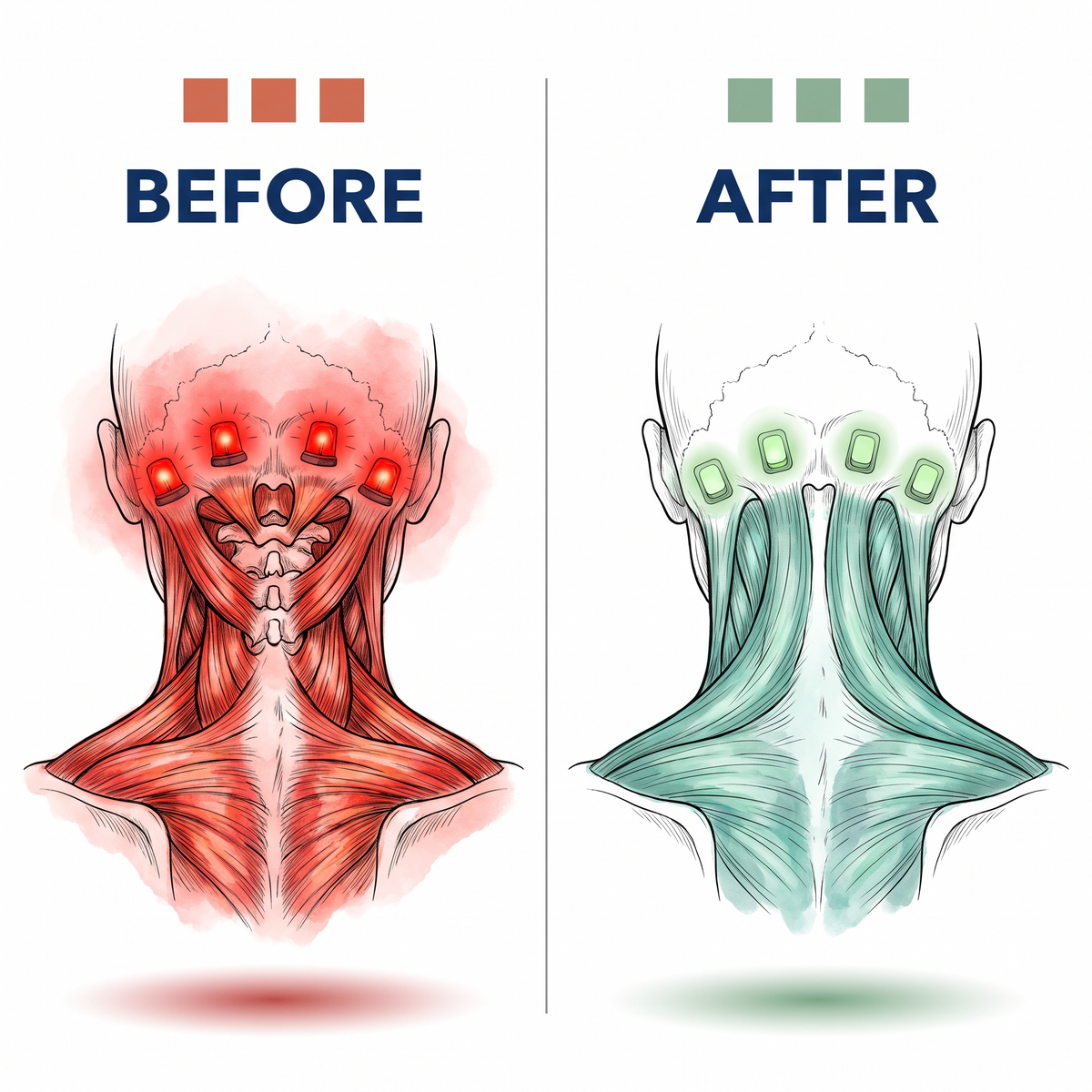
"Fibromyalgia was never 'all in your head.' But it may be in the four centimetres just below it," says Dr. Richard Calloway, the retired NHS rheumatologist behind the MagicPro 3.0. At the base of your skull sit four tender points — the same four the American College of Rheumatology used to diagnose fibromyalgia back in 1990. Think of them as switches stuck in the ON position, flooding your nervous system with alarm signals day and night.
"Every drug I prescribed for thirty-two years tried to muffle the alarm," Dr. Calloway explains. "Nobody was reaching the switches themselves. They're buried under muscle at the base of the skull — no pill targets them, and no flat TENS pad can wrap around them."
The MagicPro 3.0 was built to do exactly that: six contact points that sit directly over the switches and work in four phases — warmth to thaw the guarding muscle, EMS to reset the electrical chatter, vibration to release what's left, and red light to recharge the tissue overnight.
- REACH — six contact points curve around the base of the skull, where flat pads never arrive
- RESET — EMS, the same stimulation class tested on 459 fibromyalgia patients in the FM-TIPS trial
- RECHARGE — thirty-two red-light diodes, nightly, while you do absolutely nothing
In that trial — 459 patients, 28 clinics — the responder rate was 41% versus 13% on placebo, and 81% of patients called the stimulation helpful. It worked. It just required a clinic. The MagicPro 3.0 puts the same logic around your neck, at home, for 15 minutes an evening.

An Honest Comparison
What the £20-40 massagers, the pad machines and the £150-a-visit clinics don't tell you.
| Cheap massagers (£20-40) |
TENS units with pads (~£60 + pads forever) |
Private pain clinics (£150 per visit) |
The MagicPro 3.0 (£69.90, once) |
|
|---|---|---|---|---|
| Technology | A motor that kneads muscle — nothing more | Flat pads, basic stimulation | EMS, heat, red light — one at a time | 4 phases in one device: warmth, EMS, vibration, red light |
| Reaches the 4 switches | No — works shoulders, never the base of the skull | Only if you can place pads there yourself (you can't) | Yes — while you're lying on their table | Six contact points curved to sit exactly on them |
| Consumables | None, but it breaks in months | Sticky pads every few weeks, forever | Petrol, parking, and your afternoon | Nothing. No pads, no gel, no refills, no subscription |
| Evidence base | "Feels nice" is the entire study | Real evidence — the FM-TIPS trial used this class of stimulation | Strong, but the effect fades between visits | Built on the FM-TIPS protocol, made daily and home-friendly |
| Ongoing cost | Replacement unit, then another | £15-25 a month in pads, forever | £150 every single visit | £0. The price today is the total cost of ownership |
| Support | Overseas seller, weeks to reply | Amazon returns window | Receptionist and a waiting list | UK warehouse, UK humans, 24-48h dispatch |
Cheap massagers are not "useless" — they're simply working on the wrong spot with one tool. We prefer to show you the mechanism instead of asking you to believe a claim.
Built in Leeds by a Rheumatologist Who Watched His Wife Run the Gauntlet
The MagicPro 3.0 was not designed in a corporate lab. It was prototyped in a Leeds garage by Thomas Calloway, a biomedical engineer — working from a list of specifications written by his father, Dr. Richard Calloway, a consultant rheumatologist who spent 32 years in the NHS watching fibromyalgia patients run the gauntlet.
But the real reason this device exists is Elaine. Richard's wife did everything "right": the pregabalin, the pacing, the early nights. And at 3:17 in the morning she was still sitting on the edge of the bed, taking inventory of everything that hurt. Meanwhile the system kept telling her the one sentence every woman over sixty in this country knows by heart — "there's nothing more we can do."
"The first prototype looked like something from a mad scientist's shed. Wires everywhere. Elaine thought I'd lost it. But I knew the research — stimulation works, heat works, red light works — it was all just locked inside clinic machines costing thousands. So Thomas shrank it into something his mother would actually use. One button. Fifteen minutes. Every evening."
That garage prototype became the MagicPro 3.0 — a small British company that stocks in batches, function-tests every unit before it ships, and answers its own emails.
The Calloway standard — every unit, every batch:
- ✓ Six metallic contact points curved to wrap the base of the skull — the four switches
- ✓ EMS with 16 intensity levels, from feather-light to clinic-strength
- ✓ Soothing warmth and vibration phases built into every cycle
- ✓ Thirty-two red-light diodes for the nightly recharge phase
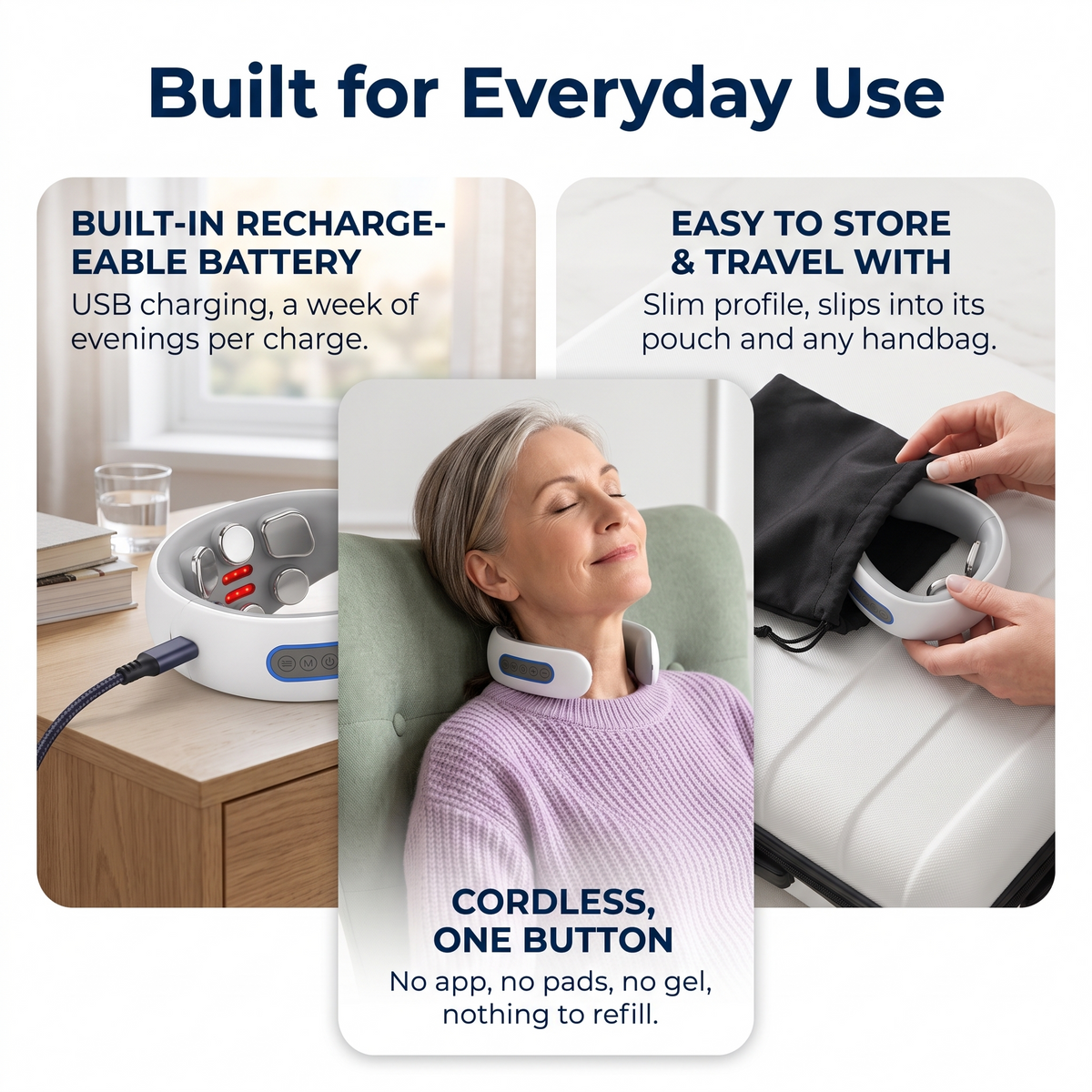
- ✓ USB charging, cable included — no batteries, no pads, no refills, ever
- ✓ Every unit function-tested before dispatch from our UK warehouse
Real Users. Real Mornings Back.
Stories shared with permission. Individual experiences — results vary.
"The inventory got shorter."
"Every morning used to start with the same head-to-toe check of everything that hurt. Six weeks in, I caught myself making the tea first and taking stock later. That had never happened. Not once in nine years."
"I slept past 4am."
"I hadn't slept through the night since 2019. I'm not going to pretend it's every night now — but last Tuesday I woke up, looked at the clock, and it said 6:40. I just lay there and cried a bit, if I'm honest."
"My GP asked what I'd changed."
"Seventy years old and I'd stopped expecting anything to work. At my review my GP said I looked different and asked what I'd been doing. I told her: fifteen minutes with this thing every evening while I watch the news. That's all."
"Bought it for my wife. She kept it."
"My wife has a drawer full of things I bought her that didn't work, so she'd written this off before it arrived. That was three months ago. She uses it every single evening and the drawer hasn't grown since."

The 90-Day "Quiet Mornings" Guarantee
Use the MagicPro 3.0 every evening for 90 days — three full months. Position it, press the button, let it work. Give the ritual a fair chance to do whatever it is going to do for you.
And if you do not wake up one morning and realise "I forgot to take inventory today"… we refund every penny.
- No forms, no "store credit", no interrogation
- Email info@health-vitalis.store and say "it was not for me"
- Send the device back to our UK address — refund processed within 48 hours
- Your statutory 14-day cancellation rights apply on top, no matter what
Frequently Asked Questions
I've tried everything for my fibromyalgia. Why would this be different?
Because almost everything you've tried — pills, creams, massagers — never touched the mechanism. Drugs muffle the alarm; massagers knead your shoulders. The MagicPro 3.0 was built around one target: the four tender points at the base of your skull, using the same class of stimulation that helped 41% of fibromyalgia patients (versus 13% on placebo) in a 459-patient clinical trial. That said, some people feel nothing at all — that is true of every health product ever sold, and it is exactly why the 90-day guarantee exists.
Is this just another vibrating neck massager?
No. A massager has a motor; that's the whole story. The MagicPro 3.0 runs a four-phase cycle — warmth, EMS with 16 intensity levels, vibration, and 32 red-light diodes — delivered through six contact points shaped to wrap the base of your skull. EMS is the phase that matters most: it's the stimulation class with actual clinical evidence in fibromyalgia, and no £30 massager has it.
How soon will I notice anything?
Honest answer: Session 1 — the warmth and the release of tension at the base of your skull; most people feel that immediately. Weeks 1-2 — probably nothing dramatic; the ritual becomes a habit. Weeks 3-6 — this is when the reports arrive: a night slept through, a morning without the inventory, stairs taken without the bannister. In the trial, benefits built over four weeks of daily use — so give it the 90 days. And if by then you feel nothing, you pay nothing.
How often should I use it?
Once a day, 15-20 minutes, ideally in the evening — that's when it prepares the muscles and circulation at the base of your skull for the night. In the trial that inspired the protocol, patients used stimulation daily for four weeks, and the longer they used it, the better it worked. Consistency beats intensity.
Can I use it with my medication?
Yes. It's a physical device — nothing enters your bloodstream, so there are no interactions with pregabalin, duloxetine, amitriptyline or anything else. Many customers use it alongside their prescriptions, and GPs are generally glad to see a non-drug tool added. Never stop or reduce a prescription without speaking to your GP first.
Does it need gel pads, batteries or replacement parts?
No — ever. The contact points rest directly against your skin; there are no sticky pads to buy, no gel to apply, nothing to refill. It recharges by USB (cable included), like your phone. The price you pay today is the total cost of ownership.
Who should NOT use it?
Do not use the MagicPro 3.0 if you have a pacemaker or any implanted electrical device, if you are pregnant, if you have epilepsy, or after recent neck surgery or injury. And never place it on the front or sides of your neck — it belongs at the back, at the base of the skull. When in doubt, show it to your GP first.
What does the EMS feel like?
A gentle pulsing or tingling — most women describe it as "fingers drumming softly at the base of my skull." You control the intensity across 16 levels and it should never hurt; start low and find your comfort. EMS at these levels has been used in physiotherapy clinics for decades.
How long does a charge last?
A full USB charge takes about two hours and powers roughly a week of nightly 15-minute sessions. A small indicator light tells you when to top up — no app, no pairing, no accounts.
What is your return policy?
90-day money-back guarantee. Email info@health-vitalis.store, send the device back to our UK address, and your refund is processed within 48 hours. No forms, no restocking fees. Your statutory cancellation rights are unaffected.